Showing posts with label NCAEE. Show all posts

Sunday, November 4, 2018

The Importance of Questioning

Albert Einstein once said, “The important thing is to never stop questioning.” Einstein is also noted for saying, “If I had an hour to solve a problem and my life depended on the solution, I would spend the first 55 minutes determining the proper question to ask… for once I know the proper question, I could solve the problem in less than five minutes.” Einstein believed that questioning and curiosity were the catalyst to learning. Trying to find answers requires a person to think. The more questions that are asked, the more thinking occurs.

The key to questioning is asking the proper questions. Questions should spark curiosity. Curiosity will ignite a fire to learn more. It is so easy for a teacher to ask the basic, lower level “right there” questions. These questions simply require students to regurgitate information they have been given. These questions may be “In which year was President Obama elected President?” “Who was President Obama’s Vice President?” “What color was Goldilocks’ hair?” “How many bears were in the house?” These questions simply require a student to look at text and pick out the answer. There is not a lot of thought put into providing the answers. Are these questions necessary? Yes they are! They are initiate recall, the first step to higher order thinking.

Higher order thinking questions are questions that require students to put together information that they have to formulate an answer. “How did his reaction to the crying child cause the child to stop crying?” requires a level of thinking beyond asking, “What did he do to get the child to stop crying?”  Both questions will provide the same basic information, but the former requires a student to analyze the information provided rather than simply recall it as with the latter question.

To assist students with their thinking, ask why questions: “Why did you think that was correct?” “Why do you believe that was the incorrect choice?” “Why did you put those pieces together instead of using the other pieces?” Asking why questions will encourage students to show understanding of what they know, apply the knowledge, and then evaluate its accuracy in relation to what they know and what they understand the question to be asking.

The highest level of questioning requires students to sort through information/knowledge they have, determine how it can best be organized and utilized, and then produce an answer based on evidence they have gleaned from their answers. These questions will be in the order of “What was the most exciting part in the story and why?” “What do you think would happen if children could make all the decisions about school?” “How could you determine which method is the best for building permanent friendships?” “What information is needed to decide the best route to school?”

Many reading this bog are thinking “That’s good for older students, but what about the lower grades, like Pre-K through second grade?” Proper questioning works for those students as well. The vocabulary will naturally change, but the type of thinking will be the same. Ask “What if…” or “How would…” or “Why is…” or “What would you do if…” These questions will generate all sorts of possibilities, but most of all these questions will generate thinking.

Never be so quick to answer the question yourself. Some students need think time. Others will realize if they are quiet for more than a second, they will not need to provide an answer. Should you inadvertently answer the question, then ask the student why that answer was the correct response. This type of questioning may cause you and your students to feel uncomfortable at first. However, if you practice enough this becomes the norm for your teaching, then students will learn to anticipate this type of questioning and start thinking outside of the traditional box.

Engage your students by questioning. Ask open-ended questions rather than the recall and remember ones. Challenge your students to think, but be prepared for them to challenge your thinking as well.


Kathy Drew is a fourth grade teacher in Wayne County Public Schools. She received her Bachelors in Elementary Education from the University of West Florida, in Pensacola, Florida and her Masters in Elementary Education from Fayetteville State University in Fayetteville, North Carolina. She is a National Board Certified Teacher. She was  selected as a 2016 Wayne County MODEL Educator (Master Educator, Obligation to a Respectful Learning Environment, Demonstrates Leadership, Effective Instructor, and Lifelong Learner). She serves as the Region 2 Director of NCAEE and is one of the original founders of the organization,

Sunday, May 20, 2018

Region 5 Conference

Plant it!  On April 19th, NCAEE Region 5 educators came together for fun, food, and fellowship all centered around planting a growth mindset in our classrooms.  Breakout sessions included topics such as establishing a growth mindset in the content area classroom and growing teacher leaders. Bruce Carroll and Aaron Burr, Davidson County administrators, presented on teacher leadership and said the conference had “energetic participants that clearly cared about self growth and building their capacity to affect the students in their care.” Going along with the growth mindset theme, attendee Janell Willard said the workshop she joined “emphasized the ‘power of yet,’ the key to our students' success in everyday problem solving and STEM activities.”

Keynote Michael Beadle wowed the crowd with an interactive poetic presentation.  In celebration of April being National Poetry Month, Michael performed the poem, “Jabberwocky” by Lewis Carroll with the assistance of audience members.  The audience volunteers hilariously put their spin on Michael’s recommended character movements, which reinforced how interactive poetry is engaging for children and adults. As one attendee said, “something simple like a poem… can turn into a dynamic experience for your students.” Michael’s enthusiasm for poetry was a refreshing reminder of the power of poetry for many struggling students.

Another takeaway was Michael’s explanation of “amateur.”  The root word for “amateur” is “amor” which means love.  As a teacher, it is an important reminder that we must work within our passion to educate students. Having a growth mindset is not only significant in the classroom, but also across our careers.

5 Fantastic Facts about Michael:
-       A+ Schools Fellow
-       Author of 5 poetry books, a poetry CD, and 3 historic photograph books
-       Former journalist
-       Touring writer-in-residence
-       Emcee for the N.C. Poetry Out Loud state finals

Michael personally inspired me with his “vowels” for the classroom.
Adapt
Engage
Invent
Observe
Understand


Our diverse population of attendees provided a glimpse into what our conference was like.


Parent/ Classroom Paraprofessional
“I was curious to learn all about the power of YET! I learned some techniques that would help foster a growth mindset to use in all aspects of life.” – Carolyn Pack

Salem College Professor
“From engaging and informative presentations, a delicious dinner, time of networking, and door prize drawings, to the closing keynote by award-winning performing poet, participants were motivated and inspired to return to their classrooms and sow the seeds of a growth mindset!” – Debbie Linville

Principal Intern
“The conference definitely provided a space for us to explore the true meaning behind ‘growth mindset’ and made me think about how I can better convey this message to my teachers.” – Chris Terzigni

5th Grade Teacher
“The sessions led conversations on how to best reinforce growth mindset in the classroom in order to ensure that students recognize the impacts of hard work and effort.” - Becky Koza

Regional Advisory Council Member
"Our conference has always been a great way to network with other teachers and administrators in the area.” – Alysha Christian

High Point University Student Teacher
"As a new teacher, I especially appreciate any chance to hear from others, so I can evaluate my practices and hone them for my own classroom." – Courtney Hedgecock


About the Author
Leni Fragakis is the Region 5 Director of NCAEE. She currently teaches 5th grade at The Arts Based School. Leni has her BA (Elementary Education, minor Special Education), MEd (Literacy), and administration add-on from High Point University.  She is working toward her EdD in cultural foundations and leadership from UNCG.

Sunday, October 8, 2017

How to Be a Happier Teacher This School Year

By Justin Ashley

We are now a few weeks into the school year.

The back to school excitement has fizzled out and the realization of high expectations has kicked in, once again-the meetings, the lessons, the grading. As the paperwork piles up, here’s 17 little things you can do this week to fight against depression, anxiety, and burnout this school year.

1. Plan a family field trip for the fall.

During a quick break or while eating lunch, plan out an out-of-town adventure for an upcoming weekend this fall, maybe you could go pumpkin picking, to Tweetsie Railroad, Scarowinds, or visit a family farm. Once you pick one out, immediately put it on your calendar.

A research study showed that just planning and thinking about your next family vacay can raise your endorphin levels by 27 percent.

2. Buy your custodian or cafeteria lady a soda from the teacher’s lounge.
Research has proven that buying stuff doesn't make a lasting difference on our mood, with one exception-buying stuff for other people. This makes us happier than buying stuff for ourselves. Tis’ better to give than to receive.

3. Tell your class a funny story.
Your kids don’t want to just hear about the curriculum. They want to learn about you! Think of a story from your past that’s gotten laughs before. Tell them a silly story about yourself to get them giggling and lighten the mood in the room.

My middle schoolers like hearing about the day I proposed to my wife. We both threw a penny in a fountain and made a wish. My wish-her hand in marriage. Her wish-A raise at work.

When I taught elementary school, my kids loved to hear about my 1st visit to the zoo as a 5 year old boy, where I got too close to a fence and was attacked by a monkey, after I smiled at him. Never smile at monkeys. Never.

4. Start your lesson off with an inspirational video.
Find a Youtube video that’s motivating. Something that lights your fire and gives you chill bumps. Here’s one of my favorites…
40 speeches in 2 minutes

5. Leave your phone in your purse or workbag. 

It’s no secret that compulsive phone checking is damaging. It moves you away from your present environment and even further from each present moment. Check your phone between blocks, on breaks, or at lunch.

6. Meditate with Headspace.

Before the morning bell rings or during your planning, set aside a few minutes to get your mind right and meditate.

Don’t know where or how to start? Try downloading this free app, Headspace. This chill dude with a British accent will walk you through it. All you have to do is put your headphones in, turn off the lights, and find a chair. It’s that easy.

7. Make a list of 10 things you’re grateful for. 
Write them down and read them aloud. Here’s 3 of mine:
I’m grateful to have a job that’s also a calling, where I get paid to do something I enjoy doing.
I’m grateful to live in a democratic country, where I have guaranteed rights listed in my country’s constitution.
I’m grateful to pay my taxes, because this money makes better roads, better emergency services, better schools, and a better community. (*This last one’s a stretch. I know.)

8. Try a simple breathing technique periodically throughout the day.
A recent study showed that war veterans who suffer from PTSD could significantly reduce their cortisol levels (stress hormones) simply by using deep, slow breathing techniques. The 4-7-8 breathing technique is the easiest, most effective one I’ve found:
Inhale for 4 seconds
Hold your breath for 7 seconds
Exhale for 8 seconds
Try this a few times when you feel stressed and see if it helps.

9. Put motivational quotes cards on your desk. 
Use some index cards and google inspirational quotes or order some off Amazon and put them on your desk. Verses of scripture could also work. Read a few at a time for encouragement.

10. Write thank you cards to students or compliment them with a sticky note.
Pick out a kid or two in class, students who are working really hard, and write them a little note of recognition. We have a tendency to instinctively spot the negative, but make it a point to point out the positives, too.

11. Smile when you greet and talk with students. 
Smiles are infectious (mirror neurons), so smile when you they come into your room. Positive classroom culture starts and ends with you.

12. Set a fun short-term goal. 
Come up with a small goal. Not a SMART goal or some big resolution, just something simple, but exciting. It should take 13 weeks or less, so you can finish it around the New Year. After tomorrow, continue doing one thing each day to reach it. That’s what I did with my kids to make  STRAIGHT INTTA OREGON, a music video about Westward Expansion that went viral. Check it out!

13. Thank your principal.
Drop in their office or stop them in the hallway and tell them thank you for something they did recently. Maybe they helped you out with a resource, or stuck up for you when a parent complained. You might be a little down that summer is over and school is back in session, but they were probably working through the whole summer. Thank them for what they do behind the scenes on the daily.

14. Exercise with kids at recess.
Join in on in the fun outside. You deserve a break, too. Walk the track with your students. Kick or throw a ball with them. Jump rope with them. Connect with kids while you are working out on the playground.

15. Do some fall cleaning. 
Purge some of your school files. Get rid of old resources. Set up a new filing system. Minimalism is a really neat documentary on Netflix that shows how liberating it can be to simplify your environment.

16. Dress super nice. 
Professional attire means more respect. Kids notice that you take the job seriously. It also feels good to get hat-tips from teachers and administrators.

17. Find your 30 minute thing.
You work ridiculously hard serving others each week, so you need to carve out 30 minutes each day to serve yourself.

Take this time to move. It could be jogging around your neighborhood, doing yoga, or playing soccer with your kid. For me, it’s boxing. Every day after school, I box for 30 minutes before I pick up my kids. That’s my ‘me’ time. It’s something I look forward to each day.

And research shows that just 30 minutes of exercise uplifts your mood for the next 3-4 hours, improves your quality of sleep, and has a similar impact on your brain as the strongest anti-depressants on the market, without the negative side effects.
____________________________________________________________________________
***Bottom Line-There are small things we can do to live healthier, happier lives today and tomorrow. Some are about the external (changing our actions and environment), others internal (changing our thought patterns). We don’t have to wait until the summertime to be happy. We don’t have to count down the  school days to each Friday.

We can be happier now.

References
Happiness Advantage
The Happiness Track

Justin Ashley is a teacher, author, and motivational speaker.  He will be facilitating a breakout session and will lead us in a closing celebration at this year's Elementary Conference! You won't want to miss him or his purple cows!

Sunday, July 9, 2017

Engaging & Empowering Educators- Join Us!


NCAEE is proud to host the 14th Elementary School Conference this fall. This year's theme is Engaging and Empowering Educators and our goal is to do just that-- make sure our attendees are highly engaged throughout the conference and leave feeling empowered to do whatever it takes to meet the needs of our students. This, in turn, will lead you to engage and empower your elementary students! Save the dates for October 22nd-24th and plan to attend the a conference specifically focused on elementary school teachers.

Once again, our conference will take place at the beautiful Charlotte-Concord Embassy Suites and Convention Center in Concord, NC. The Embassy Suites features spacious suites with separate living rooms, refrigerators and The Embassy Suites also offers a free, made-to-order, hot breakfast each morning and a nightly Manager's Reception. Staying at the Embassy Suites means you will have a great time, even when the sessions are over. The hotel is offering a reduced rate for our conference attendees so be sure to reserve a room early by clicking here.

Concord, NC is just minutes away from Charlotte and there are many things to do, including Lowe's Motor Speedway, Concord Mills, and a variety of different restaurants.

Opening Kick-Off & Closing Celebration

We are mixing things up just a bit! Our conference begins on a Sunday afternoon and ends on a Tuesday afternoon. We will have an opening kick-off session on Monday morning and Dr. Pitre-Martin will bring greetings and an update from the North Carolina Department of Public Instruction. We are so excited to have her at our event!

For the first time ever, we will have a Closing Celebration on Tuesday afternoon and NCAEE fan favorite, Justin Ashley, will speak. You won't want to leave early and miss this!

It wasn't long after being named North Carolina History Teacher of the Year that Justin Ashley started noticing signs of burnout. He knew he needed to make some radical changes in how he handled his work and personal life. In his session The Balanced Teacher Path, Justin will share his personal story—illuminating how easy it is to give your job everything you've got and leave yourself with nothing outside of school—and will show new teachers and veterans alike the self-care techniques they can employ to create work-life balance and prevent burnout. With equal parts humor and wisdom, Justin will analyze four key aspects of every teacher's life—career, social, physical/emotional, and financial—and offer practical advice to bring these areas into sync, reigniting a passion for teaching in the process!

Luncheon Keynote Speaker

This year's luncheon keynote speaker is highly acclaimed educator- Dr. John Hodge. He will present BE THE ONE! He will discuss how the education of America's youth is a challenging prospect when one considers the many burdens faced by impoverished children and their families. Research indicates that poverty need not be a barrier to academic excellence. As co-author of the book  Standing in the Gap, Dr. Hodge states, "Across the nation, schools are demonstrating that it can be done: That students can reach high standards, that all children can succeed, that the gap between white and minority students, poor and affluent, can be closed." More often than not, one caring adult can make all the difference in the world. Dr. Hodge's presentation will encourage all of us to  BE THE ONE!

Featured Speakers & Breakout Sessions

We have secured a fantastic lineup of featured speakers--Kyle Greene, Rick Jetter, Justin Ashley, North Carolina's Teacher of the Year- Lisa Godwin, The Bag Ladies, and Kathy Bumgardner. Their session titles and descriptions can be accessed here.

In addition to our featured speakers, our conference boasts over 60 breakout sessions. Our Board of Directors has selected a wide range of high-quality sessions with engaging content in the strands of Educator Effectiveness, 21st Century Learning Approaches, Active Learning, and Social Emotional Learning. We are confident our participants will find sessions relevant and will be able to apply what they learn immediately in their classrooms.


On behalf of NCAEE, we wish you a wonderful summer and hope to see you in October!


Thursday, November 10, 2016

Blended Learning for K-2 Students

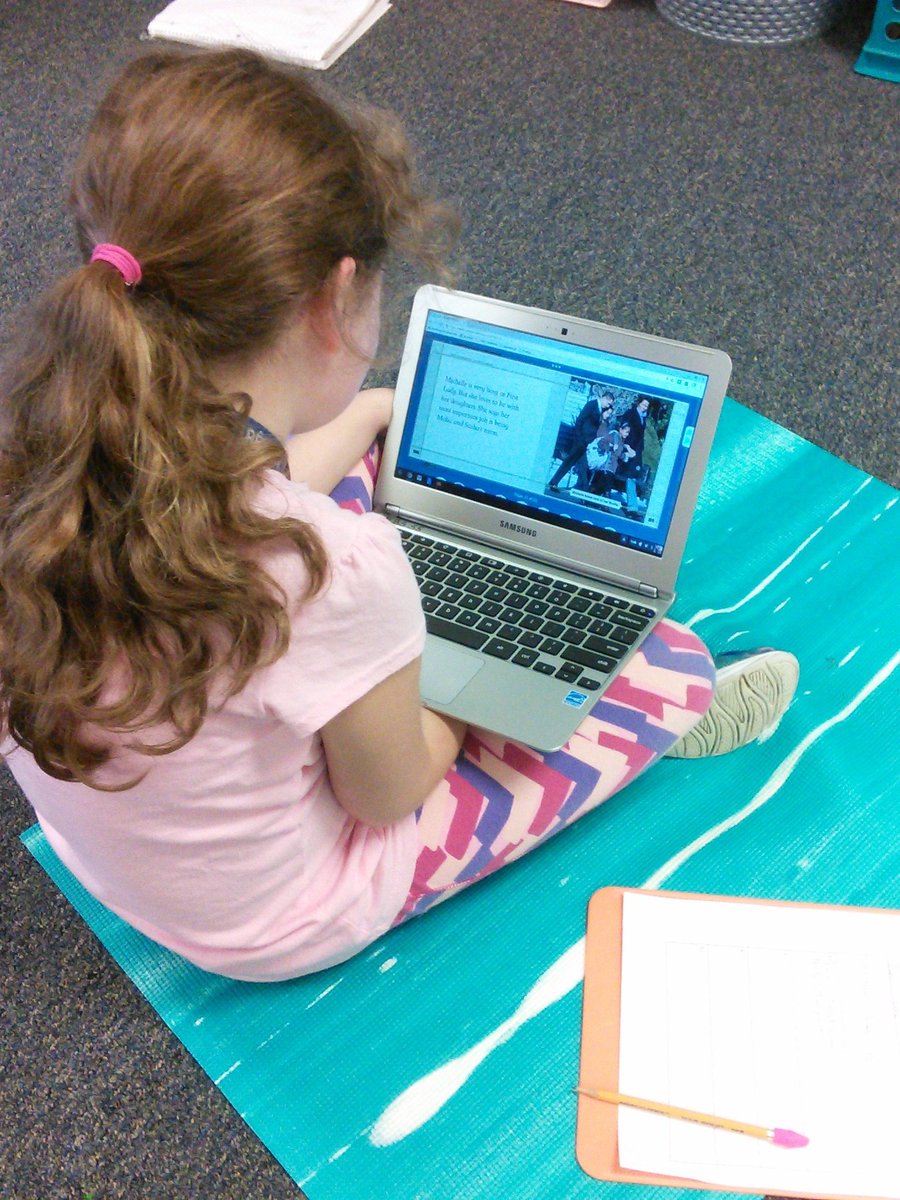
4.jpgHave you been interested in blended learning in the K-2 classroom but are hesitant to dive in? Have you been told that your students are just too young to truly utilize Chromebooks and tablets? Think again! Read on to find out how two second grade teachers transformed their classrooms into a blended learning environment and how it has impacted their students.


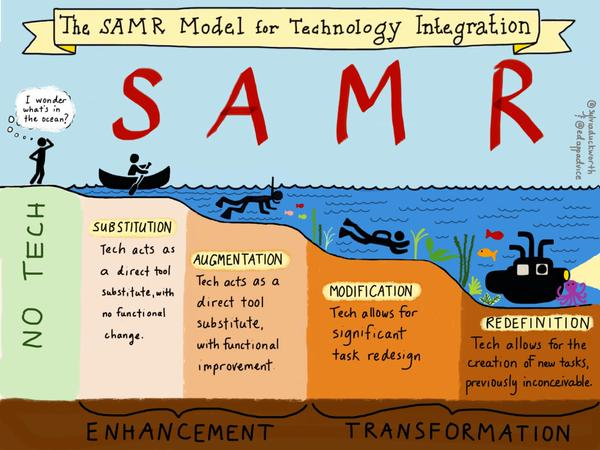
Last year, various teachers across Franklin County participated in a series of professional development sessions know as “EmpowerED”. These were led by Dr. Lisa Hervey from The Friday Institute at NC State. I (Alyssa) had the privilege of being part of this team! In these sessions, we  focused on stepping out of our comfort zone and integrating technology in various ways across the curriculum.  At first,  as a second grade teacher, I was thinking “how could I ever get my kids to do this!” But luckily in each session we got “PLEARN” time, where I could use the tools and start creating things that could work for my students. Before I knew it, my excitement for blended learning grew! As soon as I got back, I pulled Claire into my room and showed her EVERYTHING we did! She jumped right on board with me and we started planning how we could make this work! To start, we focused just on the “substitution” step of the SAMR model. This seemed most realistic for our students who still struggled to log in, find the keys on a keyboard, and know how to work a mouse!


As soon as Alyssa filled me (Claire) in on what they had been doing in their sessions, I was instantly hooked - and I knew that if WE were this excited about it, our kids would be over the moon! As Alyssa mentioned, we knew that we had to keep it simple to start with - and, full disclosure - majority of the time, we are still in the “substitution” phase of the SAMR model. Make sure that if you are wanting to implement some of the things we discuss, you move at a pace that works for YOUR students - if you throw too much at them too quickly, you won’t have the outcome you’re hoping for. Start small, and start smart.

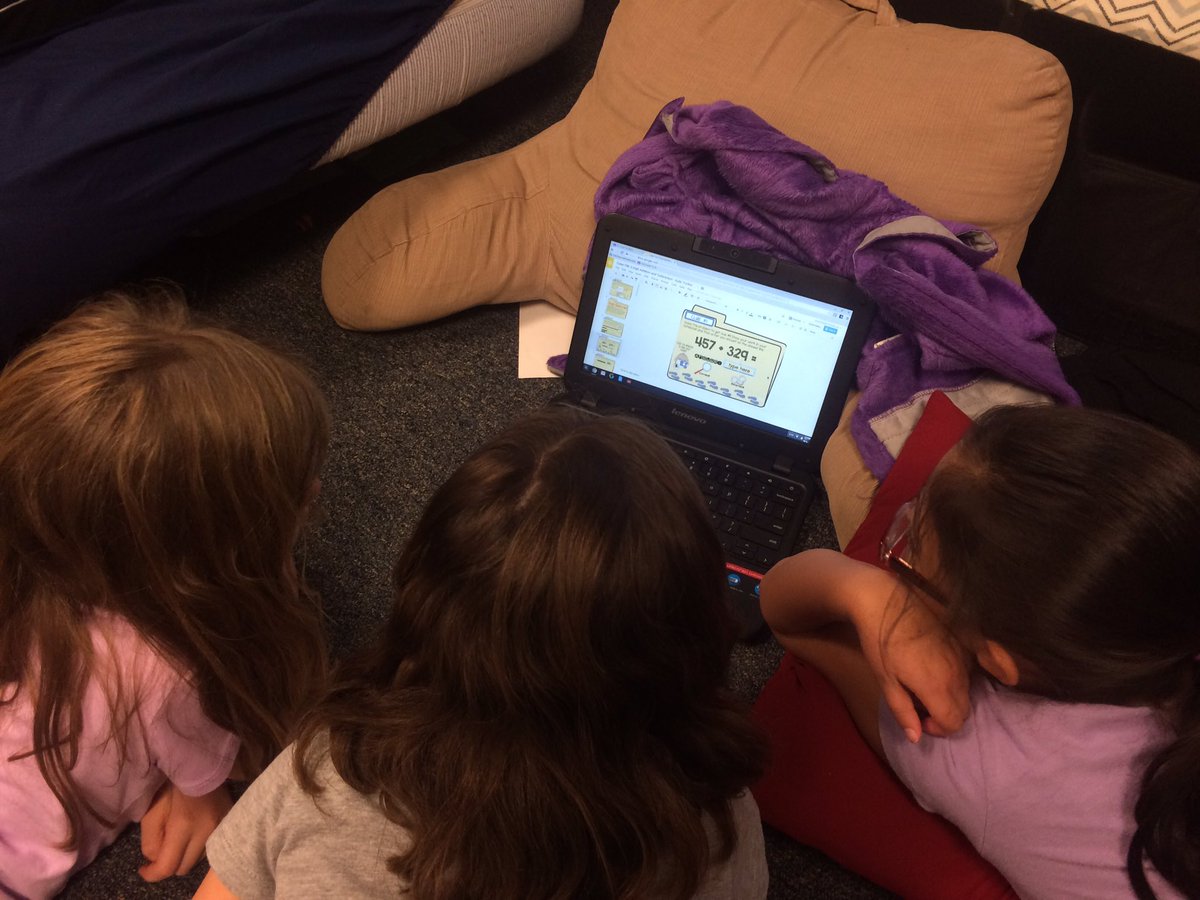
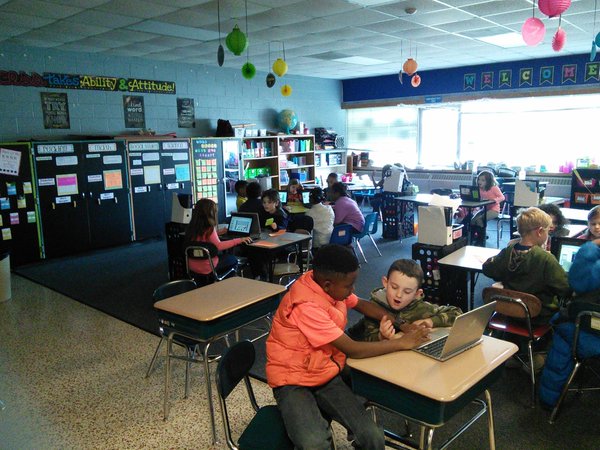
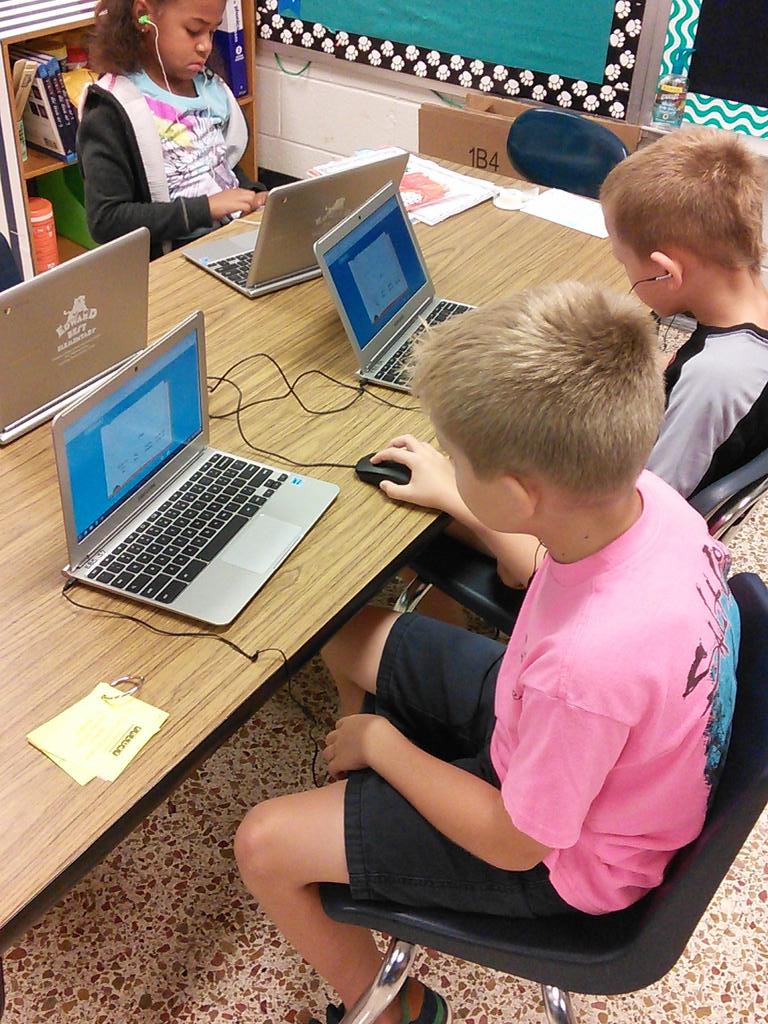
6.jpgWe know that the distribution of technology across classrooms in North Carolina (and the country itself) is grossly unequal. There are classrooms that are 1:1, and unfortunately there are also classrooms that consider themselves lucky to even have one desktop. The best part about implementing this model of blended learning is that with creative planning, it can be done with any amount of devices. When we started this journey, we each had two Chromebooks, two tablets, andtwo desktops (did we mention that we had 27 students? Don’t let your class size deter you either!) See if you can borrow technology from other grade levels - chances are that someone is at lunch or recess during the time that your kids might need devices and hopefully they are willing to share! Donor's Choose is another great option! Organize who is using which device in a way that makes sense to both you and your kids. Labels will save your sanity - assign certain students to each device so that their log-ins can be stored and they won’t have to enter their usernames/passwords each time. Alyssa is a master at organizing  the devices in a way that was equal for our students - she was able to create a rotation schedule that gave students both individual time and time to work with one another on the computers. This set-up was honestly the most time consuming part - but the payoff is worth it!

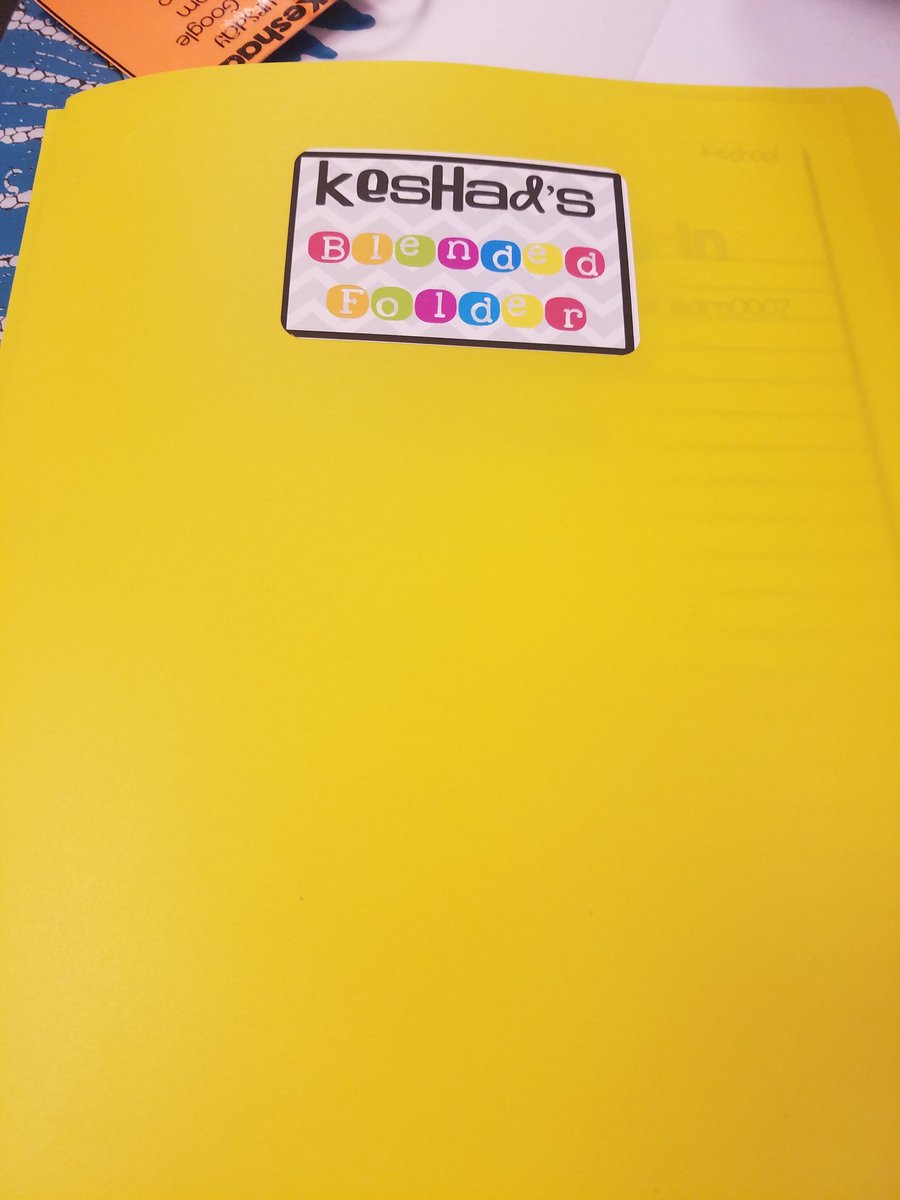
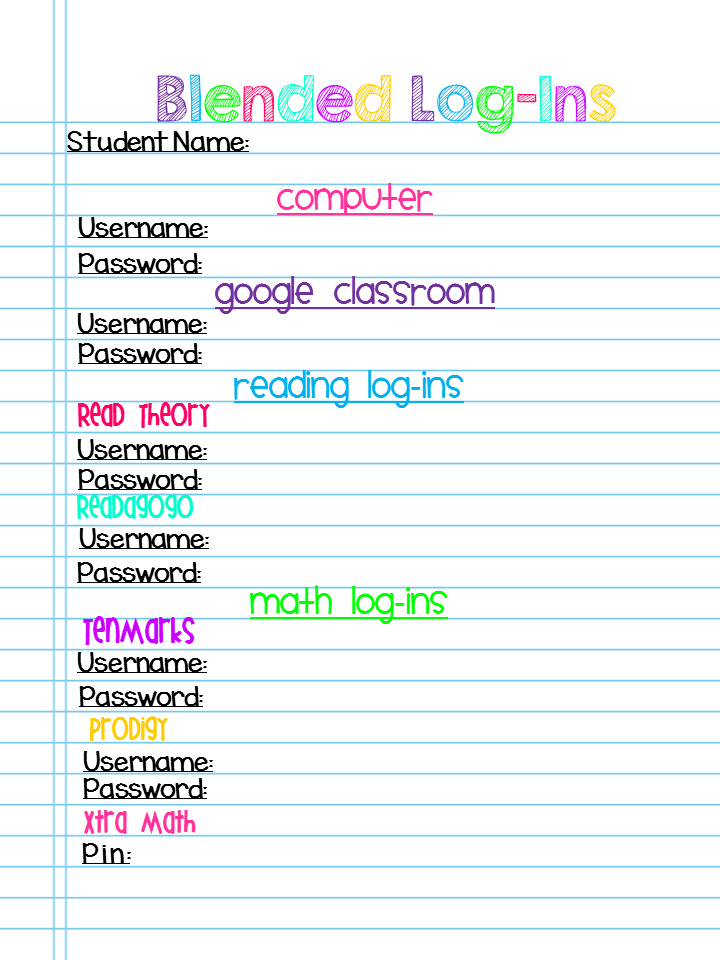
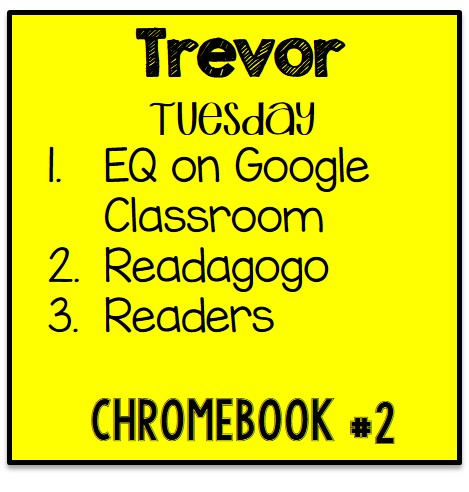
2 - Copy.jpgSlide2.PNG9.jpgWe chose to focus on implementing blended learning in ELA last year. Students had specific schedule cards (see Trevor’s on the left) and a log-in sheet inside their “Blended Folder” with every username and password they will need!  That way they have a one stop shop for log-ins for any activity they are doing! Utilize free sites first - ReadTheory, Epic, ReadWorks, TenMarks, and Prodigy  are just a few sites where you can create profiles for your students and track their progress. Google  is a life-saver when it comes to linking websites and assignments for your students. Tackk is also a great tool to link websites in one common area that is kid friendly and teacher friendly!  EDpuzzle can also be linked through Google Classroom and you can use it to create a video lesson on nearly any topic you teach! Keep an  out for grants and trials that some websites run. We were fortunate last year to receive a year’s subscription to Headsprout simply by applying for their teacher grant. The money is out there! 


No matter the amount of devices you have access to, the resources that your school allows you to use, or your number of students - the most important thing to remember is that you have to start SOMEWHERE. Choose one subject area and focus on that. Trying to implement blended learning across your curriculum from the start will more than likely leave both you and your students frustrated. Find another teacher to collaborate with. They don’t have to be in your grade level or even at your school - but you will need someone to bounce ideas off of and reflect on the process in general with. Our students will have jobs that haven’t even been invented yet - if we aren’t putting devices in their hands and getting them to collaborate with one another (both in-person and online), then we are doing them a great disservice. Our students are our future and as teachers we need to prepare them as much as possible to be successful! 

Please feel free to contact us with any questions! We would be more than happy to help you and your students! 

1.jpg5.jpg


About the Authors

Alyssa Kinary grew up in Saratoga Springs, New York and graduated from The College of Saint Rose with a B.S. in Elementary and Special Education and a MSED in Literacy. This is her third year teaching second grade at Edward Best Elementary School in Louisburg, North Carolina. She is currently a part of the EmpowerED and Differentiation teams for Franklin County Schools. 

Contact email: alyssanorthburg@fcschools.net

Claire Roehl is in her fifth year of teaching second grade at Edward Best Elementary in Louisburg, NC. She graduated with her B.A. in Elementary Education and her M.Ed in Elementary Education, both from the University of North Carolina Wilmington. She is a member of the Gamma Tau chapter of Delta Kappa Gamma, is a board member of the Franklin County Education Foundation and was recently selected as Franklin County’s 2016 Teacher of the Year. 

Contact email: claireroehl@fcschools.net


Monday, October 24, 2016

Reflections & Connections on 13th Elementary School Conference


Our 13th Annual NCAEE Conference was last weekend and my brain is still reeling from all of the fabulous information I learned.

Keynote

Hearing Kim Bearden was an experience I will never forget.  She is such an inspiration!


Kim reminded me that I always need to forgive others.  I need to find my passion and focus on the art of teaching.  I must remain positive and surround myself with people that are great examples of teaching. Above all, when a teacher has an effect on a child, you essentially affect thousands of others.


Connections

I was able to make connections with so many people in so many ways.  Social Media is a great tool with which to gain ideas and connect.  My followers on Twitter tripled and I am anxious to see how they push me to become a better teacher!  I even made friends with people outside of my county!  I love my PLN!


Presentations

I learned so much through the sessions!  Justin Ashley is such a creative teacher!  He inspires me to take my learning to a whole new level with making my classes more exciting!  I now want to be Ms. Frizzle in Science Class!

Jamie Deming really helped me to see Interactive Notebooks in a whole new light.  I want them to be truly interactive and student-centered, not solely teacher-directed.

Laura Candler motivated me to become a better grant writer and to list more on Donors Choose.  She had some fabulous ideas.  They are so easy to implement and every little bit helps when it comes to your classroom!

Kathy Bumgardner is always fabulous!  My reading lessons have never been the same since I heard her speak the first time.  She has created ingenious tools to help students take ownership of their learning.  They are so simple to use that I was able to go back to school on Wednesday and use them!

Jen Jones had fabulous ideas on how to market my TPT account and make some money!  I really enjoyed learning some great ways to “expand my brand” and supplement my teacher salary.

Vendors and Door Prizes

We had some fabulous vendors from
various publishers, to IESS, and the Biltmore House!  We even had jewelry, purses, and GoNoodle!

There were giveaways and prizes galore!  At the end of the event, some teachers took home prizes from NCAEE or our various vendors.  Who wouldn’t want to win a trip for two to the Biltmore House?

I wish I had been lucky enough to win a door prize, but there is always next year.  I do, however, feel like I won something else: more knowledge to take back to my classroom, more experiences, and more friends that inspire me to become a better teacher.  I cannot wait for our regional conference in the Spring and for next year’s State Conference!

About the Author

Megan Charlton is a third grade STEM Teacher at Patriots STEM Elementary School in Concord, NC.  She has taught Kindergarten, Fifth Grade and Third Grade.  She is in her 12th year of teaching, all of which have been in North Carolina.  She graduated from Kentucky Christian University with a B.S. In Elementary Education and Bible.  Mrs. Charlton has recently joined the NCAEE Board as Teacher At Large.  She blogs at www.CharltoninCharge.com.

Tuesday, August 30, 2016

The Impact of Social and Emotional Learning is Clear!

Teachers care for their students. We care that they grow cognitively, socially, physically, and emotionally. It is why we do what we do. In order to help students reach their full potential, it is critical to purposefully support their social and emotional development by teaching and modeling social and emotional strategies. Doing so impacts other areas of development, including academic achievement. Research shows:

  • 83% of students make academic gains when they have learned about social and emotional strategies.
  • 11% is the average gain on standardized tests for students who learn social and emotional strategies.
  • Social and emotional learning improves behaviors and attitudes toward school and prevents substance abuse. 
  • 11% is the average increase in GPA for participation in one program focused on social and emotional strategies.

How can I teach social and emotional learning? 

Begin by modeling successful Emotional Literacy. Students need to be able to label the emotions they are feeling and the emotions others are feeling. Teachers have accomplished this through having students check in as they enter the classroom and select how they are feeling with popsicle sticks and pocket charts, smart board use, and through drawings. This becomes part of their morning meeting and/or classroom routine and is discussed to model successful labeling of emotions in self and others. Teachers have used read alouds and created prompts matched to the text to ask student how characters feel throughout in the story. Using the read alouds they typically use, teachers have asked students to write on white boards, hold up feeling cue cards, and share responses in order to label characters’ emotions. 

How can I foster social and emotional development?

Once you determine how you will engage your students in these learning opportunities, you can determine where your students are growing along a developmental progression and support their development to the next step using the construct progressions developed by the Office of Early Learning. Moving their development to the next step and modeling how to get there is key to their ongoing growth and development. 

Once students can label emotions, they can learn to regulate their emotions. Again, modeling success is important. Students need to see and understand what it looks like to successfully regulate their emotions. You can discover what this looks like and model it for your students using the Emotion Regulation construct progression provided by the Office of Early Learning. 

Both of these construct progressions can be found here for your use: Emotional Literacy  and Emotion Regulation 

The Office of Early Learning is hosting several sessions this year at the 13th Annual Elementary School Conference in October. Join us to learn more about supporting student growth and nurturing the whole child! Register here today!

About the Author:

Dr. Cindy Dewey serves on the Board of Directors for NCAEE as the NCDPI At-Large Director. At NCDPI, Cindy serves as an educational consultant in the Office of Early Learning on the K-3 Formative Assessment Team. Cindy’s teaching experience spans elementary, middle, high school, and university levels. She also served as a literacy coach, building administrator, and central office administrator prior to joining NCDPI. This is Cindy’s fourth year serving NCAEE. 

Saturday, May 21, 2016

Nurturing Passion, Purpose & Potential: An Inside Look at Our Upcoming Conference!

13th Elementary Conference


We are so excited to share details of our 13th Elementary Conference! This year's theme is Nurturing Passion, Purpose & Potential and will take place October 16th-18th. Once again, our conference will take place at the beautiful Charlotte-Concord Embassy Suites in Concord, NC. Concord, NC is minutes away from Charlotte and boasts many things to do, including Lowe's Motor Speedway, Concord Mills, and a variety of different restaurants.

Luncheon Keynote Speaker

Kim Bearden, Co-Founder, Executive Director, and Language Arts Teacher at the Ron Clark Academy, is this year's luncheon keynote speaker.  She is also a best selling author and acclaimed educator who has received countless awards and recognition. Kim will motivate, inspire, and remind participants of the powerful impact that they can have, despite the pressures and challenges of their profession during her luncheon keynote: Creating a Climate and Culture of Success. Kim will also share the importance of building relationships among staff, families, and students that will motivate, engage, empower, and create success for all. She will share how to ignite a passion for learning, provide support and encouragement, hold high expectations for student behavior, promote parental involvement, and ensure a safe, secure environment for all.

Featured Speakers & Breakout Sessions

We have secured a fantastic lineup of featured speakers-- Jen Jones of Hello Literacy, former NCAEE President Laura Candler of Teaching Resources, Jaime Deming, Justin Ashley, Kathy Bumgardner, Eric Rowles will join us to share their expertise and nurture your passion for teaching! Their session  titles and descriptions can be accessed here.

Our Board of Directors recently met and selected presenters for our Fall Conference. Presenters will be notified by mid-June. We selected a wide range of presenters from throughout our state with varying levels of experience as educators. We are confident our participants will find sessions relevant and will be able to apply what they learn immediately. In fact, we think they will have a hard time selecting which ones to attend! From STEAM to Educator Effectiveness to Technology Integration, we've got it covered.

Enter for a Chance to Win! 

Has this post sparked your interest!? Would you like to attend our conference? Enter for a chance to win a FREE conference registration for the 2016 Elementary School Conference. Entering is easy! Check out the Rafflecopter below and complete easy tasks for entries, including comment on this blog post,  to win a free conference registration ($175 value!).


a Rafflecopter giveaway

Sunday, March 24, 2013

Get Energized at a NC Elementary Regional Conference!


The NCAEE has gained a reputation for hosting an outstanding Elementary School Conference each fall, but did you know that we also offer one-day regional conferences in each of the eight regions in our state?  Each session offers the opportunity to explore new teaching strategies, network with other educators, and earn CEU credit. Some sessions are on Saturdays, others are full-day workshops during the week, and others take place in the evening. Attendees also have the chance to win great door prizes like a Kindle fire or sets of math manipulatives. Registration fees are minimal and include refreshments and in some cases a meal. Our regional conferences are open to anyone; if you are interested in a conference that’s being held in a different region from where you live, feel free to attend. If you aren’t sure which region you’re in, click on the regional map in the sidebar.

Region 3 Conference – 2nd Annual RTI Forum
Earlier this month the Region 3 Conference co-sponsored the 2nd Annual RTI Forum, "Responding to New Standards." This event was held March 5th at Campbell University and was sponsored by Barton College, Campbell University, and NCAEE. It was a packed day, starting with Response to Instruction (RTI) updates related to the Common Core Standards.  Dr. Angela Hinson-Quick and Dr. Marie Petre-Martin from North Carolina Department of Public Instruction were the keynote speakers.

Over 100 attendees took part in 4 breakout sessions ranging from RtI strategies and best practices to Common Core implementation.  We were so proud to have not only the NC Department of Public Instruction, but also teachers and administrators to present throughout the day.  A network luncheon provided opportunities for participants to make connections and debrief from their sessions.  Lunch and door prizes were co-sponsored by NCAEE and Vendors. Congratulations to the Grand Prize Winner for the Kindle Fire, Vicky Temple-Rains from Johnston County Schools. Thanks to NCAEE Board Members Angela Gurganius and Jennifer Roberts who worked diligently with our co-sponsors to pull off this exciting event!

Upcoming Regional Conferences 
We have two more regional conferences scheduled this coming month and one in May. Click the title of each April session below to visit a page with more information and registration details:
  • Region 1 Conference: Instruction in the Common Core
    Thursday, April 11, 2013 – Full day session to be held at the Vernon James Center in Plymouth, NC.  Lunch included.
  • Region 5 Conference: Common Core across the Disciplines
    Tuesday, April 16, 2013 – Evening session to be held at High Point University in High Point, NC. Dinner included.
  • Region 6 Conference: Teaching & Learning in the 21st Century
    Saturday, May 4, 2013 – Morning session to be held at Irwin Elementary in Charlotte, NC.– More information and registration details will be coming soon!
If your region is not listed above, check the Regional News page on the NCAEE website in a few weeks to see when yours is scheduled. Some regional directors are planning their conferences to take place in late July or early August.  Also, make plans now to attend the 10th Annual Elementary School Conference to be held at the Koury Center in Greensboro. Registration is now open and plans are in full swing. We look forward to connecting with NC elementary educators at one or more of these events!


Laura Candler
2013 NCAEE President

Sunday, March 3, 2013

Welcome to NCAEE - It's Elementary!

Welcome to the North Carolina Association of Elementary Educators blog! This is our first official blog post using our brand new blog name. A few weeks ago we launched our blog and announced a Name the Blog contest to help us find the perfect name. We had over 80 entries, but one name in particular stood out above the rest. "NCAEE - It's Elementary!" immediately captured our attention because it's short, snappy, and it fits our organization perfectly. Our mission is to serve elementary educators and students across the state, and we hope this blog will become a place where educators can connect and share ideas. Please visit our website at www.ncelementary.org to learn more about us and what we have to offer NC teachers.

Thanks to Diann Baer for submitting the winning blog title. Diann is a 4th grade teacher in Grandville, Michigan. She loves teaching 4th grade and actually decided to become a 4th grade teacher when she was in 4th grade...and she started teaching in her old 4th grade classroom. Sounds like destiny to me! Diann won a $25 gift card to Amazon.com for her inspiration. We would love for her to visit us this fall and attend our Elementary School Conference. She would definitely be an honored guest!

Thursday, February 14, 2013

Help Us Name the NCAEE Blog!

Find the Perfect Name and Win a $25 Gift Card!

The North Carolina Association of Elementary Educators (NCAEE) is excited to be launching a brand new blog this year, and we need your help to name it. Right now our blog name is nothing more than a descriptive title - the NC Association of Elementary Educators Blog, but we're hoping you can help us come up with something a little snazzier. In fact, we're so committed to finding a great blog title that we're giving away a $25 gift card to Amazon.com to the person thinks of the perfect name!

About NCAEE
Before you can help us name our blog, you'll need to know a little about us. We were founded in 2005 by a group of dedicated elementary educators who wanted to form a nonprofit organization devoted entirely to the needs of elementary students. Each fall we host a terrific statewide Elementary School Conference that features outstanding presenters and keynote speakers from across the nation. In recent years we've been honored to have Ron Clark, Marcia Tate, Harry Wong, the Bag Ladies, and Dr. Jean speak at our event. Participants leave our conference energized and filled with renewed enthusiasm for the teaching profession. For the last few years, we've also held smaller, one-day conferences in each of our eight regions. Our goal is to provide outstanding professional development opportunities for elementary teachers across the state. You can learn more about us by visiting the NCAEE Website and signing up for our newsletter.

Our NCAEE Blog Vision
Simply put, we love kids! We enjoy teaching them and learning new strategies to best meet their needs. We are dedicated professionals who seek opportunities for professional growth among like-minded educators. We want this blog to become a place where we can share ideas and collaborate about best practices in elementary education. Our NCAEE Leadership Team consists of a wide variety of educators from classroom teachers to college professors, and each one will be contributing to this blog. We'll also invite guest bloggers to share tips, strategies, and advice for staying on the cutting edge in elementary education. Launching this blog is an exciting adventure for us, so you can see why it's important for us to find just the right name for it.

We're also reaching out and finding other ways to collaborate, too. Please follow us on Facebook, Twitter, and Pinterest to stay in touch and hear the latest conference news. You can also follow this blog using one of the links on the right.

Have you been hit with inspiration yet? We welcome ideas from all educators, not just those who live in North Carolina. If have an idea for our blog name, please enter the contest by filling out the form below. If not, keep thinking about it and be sure to return to this page when that brilliant idea pops into your head. It could be worth $25 to spend at Amazon.com. The contest will end on Sunday evening, February 24th, or whenever we find that perfect name!