Sunday, March 16, 2014

We Created, We Connected, We Collaborated…

Region 6 Conference Reflection
by Lisa Pagano, Melissa Mooney & Nancy Betler

Our second annual NCAEE Region 6 Conference was everything we hoped it would be…and more!  Nearly 75 elementary educators from across our region gathered together on a Saturday morning at Lansdowne IB Elementary School in Charlotte, North Carolina for a fun day of learning, creating, connecting, and collaborating!


After months of careful planning and collaboration, our dedicated Regional Advisory Council arrived early on the morning of March 1st and began preparing for the event. Snacks were organized and drinks were refrigerated, the Presenters’ Lounge was set up, signs were posted, and all technology was checked to ensure our day would run smoothly. We wanted to set the stage for a positive experience for everyone involved.

The day began with an inspiring, uplifting, and informative keynote session by Kathy Bumgardner. She validated the crowd and kept them engaged and smiling throughout her entire keynote with her wonderful sense of humor, entertaining photos and slides, and anecdotes. You could hear the laughter emerging from our crowd down the hallway! She also shared fun, practical, and interactive strategies to help students and meet and exceed expectations for CCSS in English Language Arts.

The breakout sessions were amazing!  We could not have asked for a group of better presenters.  We had sessions on topics such as Using Interactive Notebooks in the Content Areas with Jaime Deming, a session that taught teachers how to effectively utilize interactive notebooks into the content areas to help you differentiate instruction to Expanding the Impact of Great Teaching with Blended Learning with Romain Bertrand, which shared how blended learning can allow you to reach more students in a personalized way.


We also had sessions on technology integration, balanced literacy, student leadership, and differentiation to meet the needs of all learners. Our interactive and engaging breakout sessions truly provided something for everyone. Our participants were able to customize their experience at our conference. Experience our conference through the eyes of one of our presenters and attendees, Gretchen Schultek. Click here to read her blog post and see the terrific pictures she shared!

We enjoyed a delicious lunch from Firehouse Subs while connecting with one another. Each participant was entered for a chance to win door prizes. The two big door prizes were a session with Kathy Bumgardner and a Kindle Fire! These lucky winners were so excited and can’t wait to take advantage of their prizes.


Thank you to everyone who made our 2nd Annual Region 6 Conference a great success!  We can’t wait to start planning for our 2015 Region 6 Conference! In the meantime, you can keep up with our region by following us on Twitter, joining our Facebook group, and checking out our website.

We are thrilled that the 11th Annual State Elementary Conference will take place in our region-in Concord (October 19-21, 2014)! Have you registered yet?  We hope to see you there!

Monday, February 24, 2014

Create, Connect, & Collaborate

Updates from Region 6
by Lisa Pagano & Melissa Mooney

Region 6 has been hard at work to ensure that our second annual conference is a positive and inspiring experience for all!  Last year we hosted our first regional conference and it was a great success! Nearly one hundred educators across our region came together for  a thrilling half day of learning.

This year, our regional conference will span an entire day and features renowned educator and consultant, Kathy Bumgardner, as our keynote speaker. We know she will set the tone for a fun and energizing day full of learning, networking, and collaboration! Our theme this year is Create, Connect & Collaborate. and that is just what we will do on Saturday, March 1st at Lansdowne IB Elementary in Charlotte, NC.

Create…
  • new learning opportunities for our students
  • to show what you have learned
Connect…
  • with other educators across our region
  • with your students
  • with content and different strategies, and tech tools to make learning come to life!
Collaborate…
  • with one another
  • to grow professionally
In addition to our incredible keynote speaker, we will offer a variety of highly engaging breakout sessions facilitated by distinguished educators across our region! With sessions focusing on differentiation, balanced literacy, science, and technology, there is sure to be something for everyone! You can find out more information about the breakout sessions here.


We guarantee that our conference will equip you with the knowledge and skills needed to help you encourage your students create, connect, and collaborate. After all, these are just a few of the critical skills our students need to be successful in the 21st century.

We hope you can join us! Click here to register and create, connect and collaborate with us!

Saturday, January 25, 2014

4 Terrific Classroom Library Makeover Tips

By Dr. Debbie Linville

Now is the perfect time to give your classroom library a facelift.  The books you took great care to shelve by genre or place in labeled bins in August have likely found new homes in nooks and crannies around the room or are simply MIA at this point in the school year. The meeting space rug is soiled, the book doctor basket is full, the beanbag has more duct tape than beans, and the plant that once gave the space that special touch has failed to survive the drought. Sound familiar?

No worries!  Now is the time for starting fresh, tidying things up, and recharging. Sprucing up the classroom library will no doubt require you to roll up your sleeves and possibly, moan and sweat a bit, but what could be any better motivation than knowing your efforts will have a direct impact on promoting engaged, proficient, joyful readers? The research is clear....reading more is directly linked to reading (and writing) better. So, what are you waiting for?  Let’s get started!

While there is no single "best way" to set up a classroom library, there are four tips I have found helpful in setting up a classroom library that I am eager to share with you.


Tip #1:  Organize for ease of retrieval and replacement

Organization is key! When you think about how to organize the plethora of titles you have generated over the years,  think about the importance of grouping texts together that have something in common and think about labels that let everybody know exactly what texts they should expect to find in that section. You may prefer to sort by genre, author’s last name, topic, theme, or any number of ways. Maybe now is the time to shake things up a bit – why not try a new organizing scheme and get the students involved in the process? The most important consideration is to look at the titles you have and determine what makes sense to you and your learners. Labels are critical! Having labels on the texts and corresponding labels on the shelves, bins, baskets, or other storage devices enable readers to be independent in both the retrieval and replacement process.  Here is a great website for FREE labels – print, laminate and fasten!


Tip #2:  Move beyond the cozy corner                   

Think about the successful book stores. Books and magazines are everywhere! For me (a self-professed bibliophile), the aesthetic allure of being able to reach out and touch oodles of my paper friends at every turn is irresistible! This is what we want for our readers – the inability to leave book shelves, bins, and baskets without one or two titles in their hands. Most classrooms boast a cozy corner, which is fantastic, but what about branching out and making texts available all around the room? Just think about the possibilities. Could nonfiction titles be located in one part of the room and fiction in another? What about a special space for poetry, Big Books, multiple copies of titles for buddy reading, magazines, newspapers, graphic novels, wordless titles, and student created works? Get creative – look at the texts you have and the layout of your room through new eyes!

Tip #3:  Create Attractive Displays

When you walk into a public library or book store, think about which books catch your eye. The ones on the end cap, featured on a table top, or on the shelves with the covers facing you, right? Try mimicking that in your classroom and watch the titles fly off your shelves!! Try a new display with books by a featured “Author of the Month” or permit students to make recommendations to peers and feature those in a special spot in the room. Try having a section called “Teacher Picks” – you will not believe how desirable these books are to your students!!  Do you have a special event or fieldtrip coming up you can frontload with independent reading material? What about supplementing required content area reading with many and varied texts across genres and levels of challenge? I guarantee that if you rotate titles often enough and make them visually appealing, they will find their way into the hands of engaged, happy readers! Don’t have enough bookshelf space? How about gutters?  That’s right…..rain gutters! The image below shows how rain gutters can make an easy way to display books.


Tip #4:  Build Your Library and Catalog your Texts  

Classroom libraries are living organisms in that they continually grow and change over time. I think two things are important to keep in mind:
  1. Take stock of the genres presently in your collection and see where there are holes – fill those in with new acquisitions before you add to existing genres. Teachers, me included, can be guilty of purchasing titles in genres they enjoy. If science fiction is not your cup of tea and you have no offerings for that 4th grade reader who talks nonstop about time travel and space adventures into galaxies far, far away, you could very well miss out on that one opportunity to propel him to new reading heights. It is critical we stay on top of what is “hot” and learn about new authors so that we can make appropriate recommendations to our students. There is nothing more motivating for a reader than for his teacher to say, “I was thinking about you when I read this and I bet you would really enjoy it. Have a go and then let’s talk about it together.” Wow!!
  2. Know what titles you own! This is one thing I wish someone had told me about sooner! In my first few years of teaching I gobbled up books as fast as I could and donned with my personalized ink stamp, I made sure to place my name on the inside cover of every one of them. The trouble was, I had no idea which books I owned, how many, or what genres – I was happy just to see my shelves, buckets, and bins expanding. Big mistake! I realized the error of my ways and rectified the situation.  It was a slow process, but it was totally worth it. Whether you are just starting your teaching career or you have been teaching for decades, it is not too late. There are many ways to catalog, but I am happy to share LibraryThing, a terrific tool I really like.

When you have plentiful offerings across all genres, topics, and degrees of challenge (and a way to see at a glance the current text inventory), you can be certain there is something irresistible for every reader on your shelves!  Do you have a checkout system and if so, is it for classroom purposes only or do you permit students to take books home to read? Whether or not you incorporate a check out system, I would encourage you to have a formalized “shopping day” system in place. This will ensure that all readers have a time every week or two to browse and choose titles that are “just right” for them to read independently.    

Benefits of a Classroom Library Makeover

Revitalize, refresh, and rejuvenate your classroom library with two purposes in mind:
  1. To optimally support your instruction
  2. To grow proficient, engaged, and lifelong readers
I hope you decide to make 2014 the year to overhaul your classroom library. One thing I know for sure, it will be time and energy well spent. The payoff is enormous – a classroom full of students with large reading appetites, engrossed in texts they simply cannot put down….it does not get any better than that!  

Dr. Debbie Linville is the Department Chair of the Elementary & Middle Grades Education at High Point University.  She has been involved with NCAEE since 2005 and is currently the Director of Region 5 and Chair of the NCAEE Regional Advisory Councils.   Dr. Linville has been teaching for over 30 years and her passion is enabling educators to promote the proficient, joyful reading and writing lives of children.


Sunday, January 5, 2014

Help! I Have To Use Technology with K–2 Students!

Guest Blog by Tya Tyrell

I have often heard K–2 teachers ask “How do I integrate technology when many of my students are just learning to read and write?” Well I have a solution for you. In this blog post, I will share some ideas for simple and engaging ways to integrate literacy and technology. There are only a few steps in order for you to get started.

Integrating Technology with Ebooks
My school uses the Being a Writer™ program, which includes the writing process as students learn to write. One simple way of including technology is publishing student work through an eBook. After completing a unit in Being a Writer, students have written a story that’s ready to be published. I ask my students to pick out a piece they would like to make into an eBook. You can use PowerPoint to create an eBook. Here are the steps:
  1. Simply have the students create a slide for each section of their story (beginning, middle, and end, or chapters).
  2. Don’t forget a Title Page slide.
  3. Once the students have typed their story, show them how to import clip art or pictures from a file to help enhance their story.
This is just one way of creating an eBook. If your students are more advanced with the use of technology, try Bookbuilder.cast.org or Studentreasures.com. Here, students can type, draw, and import pictures to create eBooks, or they can turn their books into published pieces (either paperback or hardbound).


Virtual Field Trips to Integrate Technology
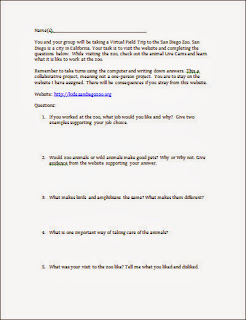
Another way to integrate technology with literacy is to create a virtual field trip to meet the Common Core Standard of asking and answering questions. A virtual field trip is a way to have students explore one or more designated websites while purposefully reading for information. As a teacher you will need to set a purpose (for example, visit Sea World to learn about ocean life) for your virtual field trip as well as a list of questions based on what you want the students to visit. I use open-ended questions to check for understanding rather than short, one-word answers. I create questions according to my students’ abilities.

You can see an example of a virtual field trip form by clicking on the image on the right. The virtual field trip my students love is a trip to San Diego Zoo. They have live webcams and a kid section including audio for non-readers as well as games. This form is a Word document that you can customize with your own questions.

Some of you might ask how I manage a virtual field trip in my classroom. I have students in pairs or small groups to work on answering questions. Every day, a few groups of students use the computers during literacy block time. I have bookmarked the website they are to use and modeled how to use the Internet and the website. With the younger grades, I only have the students use one website with links from that website. For instance, I use kids.sandiegozoo.org, where there are no ads for the kids to accidentally click on and many links to navigate.


Tya Tyrrell is a second-grade teacher in North Carolina. She has been teaching for eleven years and has completed her National Boards Certificate and has a masters degree in elementary education. Additionally, she has Gifted and Intelligence License. Tya also works part time as a consultant with Developmental Studies Center.


Sunday, December 1, 2013

Looking Ahead to the 2014 Elementary School Conference

Help NCAEE Plan Next Year's Conference!

Did you attend the 2013 Elementary School Conference in Greensboro? It was an amazing event with over 70 sessions, a terrific Keynote, and over 450 enthusiastic attendees. Last year our theme was "Common Core and So Much More," which described our sessions perfectly.

Seeking a Conference Theme for 2014
Now we're looking ahead to the 2014 Elementary School Conference which will be held at the Charlotte - Concord Embassy Suites Resort. We want to find the perfect theme because this decision will guide us in selecting our keynote, featured speakers, and sessions. We've mulled over a few ideas, but we haven't made a final decision yet. Above all, we want something upbeat and inspirational that will set the tone for an amazing conference. Since we've used the Common Core in our theme for the past few years we are not planning to include it this year although we'll offer sessions on Common Core topics.

Share Your Suggestions and Enter to Win!
This is YOUR conference too, so we've decided to open the discussion up to our past and future participants to see what you think. To stimulate your creative juices and get you thinking, we've decided to give away one free conference registration (valued at $150) to the first person to suggest the theme we select for the conference. If we don't select a theme from the ideas shared here, we'll do a random drawing of all entrants so that someone will win the free conference registration.

To clarify what we want, we are seeking a theme that consists of a short phrase or several words. A theme is more than a one-word topic and it's usually not a complete sentence. We need a stand-alone phrase that makes a clear statement about what the Elementary School Conference will offer in 2014.

Perhaps a better place to begin would be to ask what you hope to see at the conference this coming year. Would you like us to bring back a favorite speaker or offer sessions on a specific topic? Do you know of a great keynote speaker you would like to recommend? We would love to hear all of your suggestions, and understanding what you want from this conference will help us find the perfect theme.

How to Submit Conference Themes and/or Suggestions
To submit your theme ideas or share suggestions for the 2014 conference, please click the Google Doc link and fill out the form. The entry form will close when we have found the perfect theme for the 2014 conference! We will add all email addresses submitted to our newsletter list to keep you informed about the coming conference including the which theme we select. We look forward to a terrific conference in the fall of 2014!

Laura Candler
NCAEE President 2013-2014

Tuesday, November 26, 2013

Energized by the Elementary School Conference!

Guest blog post by Giselle Mansi

“A teacher is a compass that activates the magnets of curiosity, knowledge, and wisdom in the pupils” -- Ever Garrison

This year I was privileged to attend the 10th annual North Carolina Association of Elementary Educators Elementary School Conference held on October 20th though the 22nd. Before I begin sharing with you about the remarkable experience that I had, I just need to give a big shout out to everyone who partook in organizing this magnificent event! ‘Kudos’ to the NCAEE officers and regional directors for throwing down the house-- teacher style!!

As a college senior and future educator, I cannot begin to tell you the amount of resources that I took away from this conference! From learning just about everything about “rice” through stations, to learning about how my students can participate on the NC Science Olympiad, to celebrating diversity through children’s literature, to creating a prosthetic hand out of forks, spoons, and popsicle sticks, to feeling like a child again after creating all sorts of foldables and lastly, to remembering the reason why I decided to go into teaching in the first place and remembering to find those bright spots in our lives… these workshops were just a glimpse of how much I learned and took away from the conference. Not to mention, all the other great workshops that my friends also attended and enjoyed!

Additionally, I had the opportunity to listen and learn from our keynote speaker Kelly Bergam who was the highlight of my conference experience! Reminding myself to have humor in life and to take baby steps when the load gets heavy were some of the wonderful tips that Kelly gave us throughout her presentation. How many times have we felt being on the verge of ‘breakdown’ because we were trying to juggle deadlines, commitments with our professional and personal lives alongside with anything else that may come along unexpectedly? I know I have had quite a few of those moments myself and that’s why sometimes it is important to pause and enjoy the moment. When life gets overwhelming, take one step at a time. Take a minute to relax, breathe, prioritize, and find the joy in what you do! As I once heard, sometimes we get so focused on the finish line, that we fail to enjoy the journey!

I am so appreciative of all the presenters who took time to prepare and put on amazing workshops for all of us! Honestly, I enjoyed all of them so much and I got so many good resources from all of them! If any of you were in the “Gearing Up for Engineering” session, you know how challenging, but engaging, that workshop was! I will never forget building a prosthetic hand out of random things. Great stuff I tell ya! I also took away some great classroom management ideas from Kelly’s session that she did right after her presentation and loved how she kept reinforcing her “baby steps” analogy to getting things done! In other words, one baby step at a time!

Also, here’s my sad moment of my entire conference experience… Ready? I cannot believe I missed Jennifer Jones’ blogging session! I’m still kicking myself about it! I follow her blog, and I LOVE everything she has on TeacherPayTeachers but somehow I missed the chance to FINALLY meet her in person!  (Some background info, Jen Jones is like my all-time celebrity blogger!)

Lastly, let me not forget to share a little something about all the freebies I took home during the conference! WOW! I hope everyone took a poster to use in the classroom. I know I did and I can’t wait to show it off! I hope everyone who attended had as much fun as I did and took plenty of ideas to implement in the classroom; otherwise, we fail to keep up with the needs of our students.

I’m already excited to attend the 2014 conference that will take place in October at the Charlotte-Concord Embassy Suites Resort. If you missed the conference this year for any reason, I highly recommend and invite you to attend next year’s conference! I promise you will not regret it. Even if you are afraid of going alone, don’t be. You will meet many others the minute you get there and they will make you feel right at home. Until then, I hope everyone has a great rest of the year and enjoy all the many festivities that November and December bring…

Giselle Mansi is currently perusing her Elementary M.Ed. with a literacy concentration at High Point University.  She is the President of the High Point University NCAEE cohort and is a member on the Regional Advisory Council for Region 5.  Giselle is a dedicated teacher and is committed to helping spread the word about the benefits associated with being a member of the North Carolina Association of Elementary Educators.  

Wednesday, October 2, 2013

Coping with Teaching and Testing to New Standards

In education, change is a way of life…

As you know, the old NC Standard Course of Study has morphed into the overhauled Standard Course of Study, which comprises the Common Core State Standards (CCSS) and the NC Essential Standards (NCES). These new standards establish educational learning targets aimed at ensuring that all students are prepared for success in college and work.

You know… the “21st Century Skills" we’ve heard so much about during the last decade or so.

The NC State Board of Education mandated that the CCSS and the NCES be taught and assessed starting with the 2012-2013 school year. Large-scale testing for the CCSS is set to launch in fall 2014.

These new standards call for a significant elevating of learning expectations that focus on deeper understanding of content and higher levels of thinking and application… for both students AND teachers!

Marzano, Waters, and McNulty (2005) describe two types of changes that take place when innovations are introduced into schools. They use the terms first-order change and second-order change to describe the magnitude and implications of changes for the educators who are expected to implement them or for those individuals who will be impacted by the changes.

First-order change is a logical extension of past practices and can be put into place with current levels of knowledge and skills. This type of change is superficial and incremental and does not require educators to do things in significantly different ways. In first-order change, the current situation is tweaked only a little bit at a time.

Conversely, second-order change is “transformational” and necessitates a fundamental departure from past practices. For successful implementation, second-order changes require individuals to acquire new knowledge and skills in order to bring about dramatic differences in practices from those currently being used.

Would you agree that teaching and testing to the new standards are examples of “second-order change?”

How are you coping with this new reality? What changes must you make in your teaching in order to ensure that your students meet the higher expectations of the new standards? What short-term and long-term steps can you take to make positive changes in your teaching practices?

Helping You Cope with Transformational Change


There’s one fantastic opportunity to help you cope with transformational change coming up very soon…

Could you benefit from participating in a powerful learning experience? Why not consider attending the 10th Annual Elementary School Conference coming to the Koury Convention Center in Greensboro on October 20-22, 2013?

As you may know, the Elementary School Conference is hosted by the NC Association of Elementary Educators (NCAEE). This volunteer organization is the only one in our state, and one of only a few in that nation, dedicated to meeting the needs of elementary educators and students.

The theme for this year’s Elementary School Conference is "Common Core and So Much More!" The conference strands focus in on topics of interest to most elementary educators: Common Core, Essential Standards, Teacher Leadership, Supporting Diversity, and Technology in Education. Click here to take a look at the fantastic sessions being offered this year.

If you haven't yet registered for the conference, you can do so from the NCAEE website. There is a team discount available: pay for four attendees and get one free. Attending a conference with a group can be terrific fun as well as enlightening! Download the Team Discount form for details.

If you are not sure if your school has funds available now, it is possible for you to attend the Elementary School Conference in October and pay later. This year you can attend in October and pay as late as November 15th if you have an administrator sign and send in a Payment Authorization Form. Read about this offer on the NCAEE blog.

Plus, are you looking for ways to demonstrate your leadership in the profession? You know… Standard I of the NC Professional Teaching Standards on which you are evaluated each year.

If so, then consider joining the NCAEE Team! If you would like to take on an active role in our organization, we currently are seeking Regional Advisory Council members in many of the eight regions of NC. Find out how you can get involved by reading the blog post about this. We would love to have you join our team!

If you have not done so already, sign up for the NCAEE newsletter to receive updates throughout the year.

We hope to see you at the 10th Annual Elementary School Conference in Greensboro in a few weeks!


Dr. Sara Coble Simmons is the Founding President of NCAEE (2005-2006) and remains actively involved by serving as the At-Large Professor member of the Board of Directors. A former elementary teacher, she has been involved in various facets of education in three different states. She holds a Ph.D. in curriculum and instruction from the University of Texas at Austin. She is past dean of graduate studies at the University of North Carolina at Pembroke and currently is a full-time professor in the School of Education at UNCP. At the upcoming Elementary School Conference, Dr. Simmons will be presenting a breakout session entitled “Putting it All Together: Teaching to the Standards in NC.” She can be reached by email (sara.simmons@uncp.edu).

Reference:
Marzano, R. J., Waters, T., & McNulty, B. A. (2005). School leadership that works: From research to results. Alexandria, VA: Association for Supervision and Curriculum Development (ASCD).